Building People-Centred Workplaces
Turning difficult conversations into simply... conversations and helping growing organisations protect the human culture their business was built on.
Here at Halcyon, I help growing organisations protect the culture they were built on, support staff through real life, and give managers the confidence to handle difficult conversations well.
I work with founders, HR leads and leadership teams to create workplaces where people are supported through the realities of life - without losing clarity, boundaries or business focus.
Because the strongest organisations are not those that ignore real life.
They are the ones that know how to respond to it well.
As organisations grow, it becomes harder to rely on the informal “we know each other” culture that once held everything together.
Managers become responsible for conversations they may never have been trained to handle.
Staff experience can become inconsistent.
And even good policies can fall flat if the human response around them does not feel safe, clear or compassionate.
Halcyon helps organisations close that gap.
Whether you are beginning to explore your wellbeing and people-support gaps, need practical training for managers, or want to build a fuller Person-Centred Workplace Framework, Halcyon can help you find the right next step...
Book an exploratory conversation with Sarah today to find out how this could look for your organisation or if you've just got a quick question, feel free to pop a question in the chat box in the bottom corner - if I'm not here right now, your chat will land in my inbox and I'll get back to you as soon as possible - you'll still be chatting with me not a bot.
The Challenge Growing Organisations Face
Most organisations begin with a strong culture of care.
Founders know their people personally.
Decisions feel human.
Trust, flexibility and common sense often shape how things work.
There is often a kind of “mates vibe” - not unprofessional, but relational.
People know each other.
They notice when someone is not themselves.
They make adjustments quietly.
They have conversations in the moment.
They care.
But as organisations grow, that informal culture becomes harder to protect.
More people join.
Teams spread out.
Managers take on more responsibility.
Policies become more formal.
Leaders are further away from the everyday experience of staff.
The organisation may still care deeply, but care is no longer carried by closeness alone.
That is often where the gap appears.
The business still believes it is a caring workplace but staff may experience support differently depending on their manager, their team, their role, their confidence speaking up, or whether anyone has noticed they are struggling.
And managers are often left holding complex human moments they have never been trained to handle.
A team member discloses a pregnancy loss.
Someone is struggling with menopause symptoms.
A staff member is caring for a parent and quietly burning out.
Someone is grieving.
Someone is experiencing domestic abuse.
Someone’s performance has changed, but the reason is personal, painful or unclear.
The policy may exist but the conversation still has to happen.
And if managers do not know how to respond, the experience can become inconsistent despite everyone’s best intentions.
Some managers become too formal too quickly.
Some avoid the conversation altogether.
Some try to be kind but overstep.
Some say nothing because they are scared of saying the wrong thing.
Some make promises they cannot keep.
Some miss early signs until the situation has already become a crisis.
This is how good organisations end up with uneven staff experiences.
Not because they do not care but because care has not yet been translated into consistent leadership practice, confident conversations, clear support routes and everyday culture.
Too often, workplaces only respond once problems are already visible:
- absence,
- declining performance,
- difficult conversations,
- fractured relationships,
- formal HR issues,
- overwhelmed managers, or
- talented people quietly leaving.
It does not have to work this way.
A People-Centred Approach
Person-centred workplaces recognise that people bring their lives to work.
That does not mean workplaces need to become counselling rooms, crisis centres or places without boundaries.
It means care is no longer left to chance.
Leaders and managers have the confidence, language, policies and practical structures to respond to real-life issues with compassion, clarity and consistency.
Staff know where to go, what support exists and what is likely to happen if they raise something sensitive.
Managers understand how to listen without overstepping, how to hold boundaries without becoming cold, and how to respond in a way that protects both the person and the organisation.
A person-centred approach helps organisations move from reactive wellbeing to culture before crisis.
It supports people earlier, gives managers clearer guidance, and helps leaders make better decisions about the kind of workplace they are building.
This is not about performative wellbeing. It is about designing care, trust and practical support into the way the organisation actually works
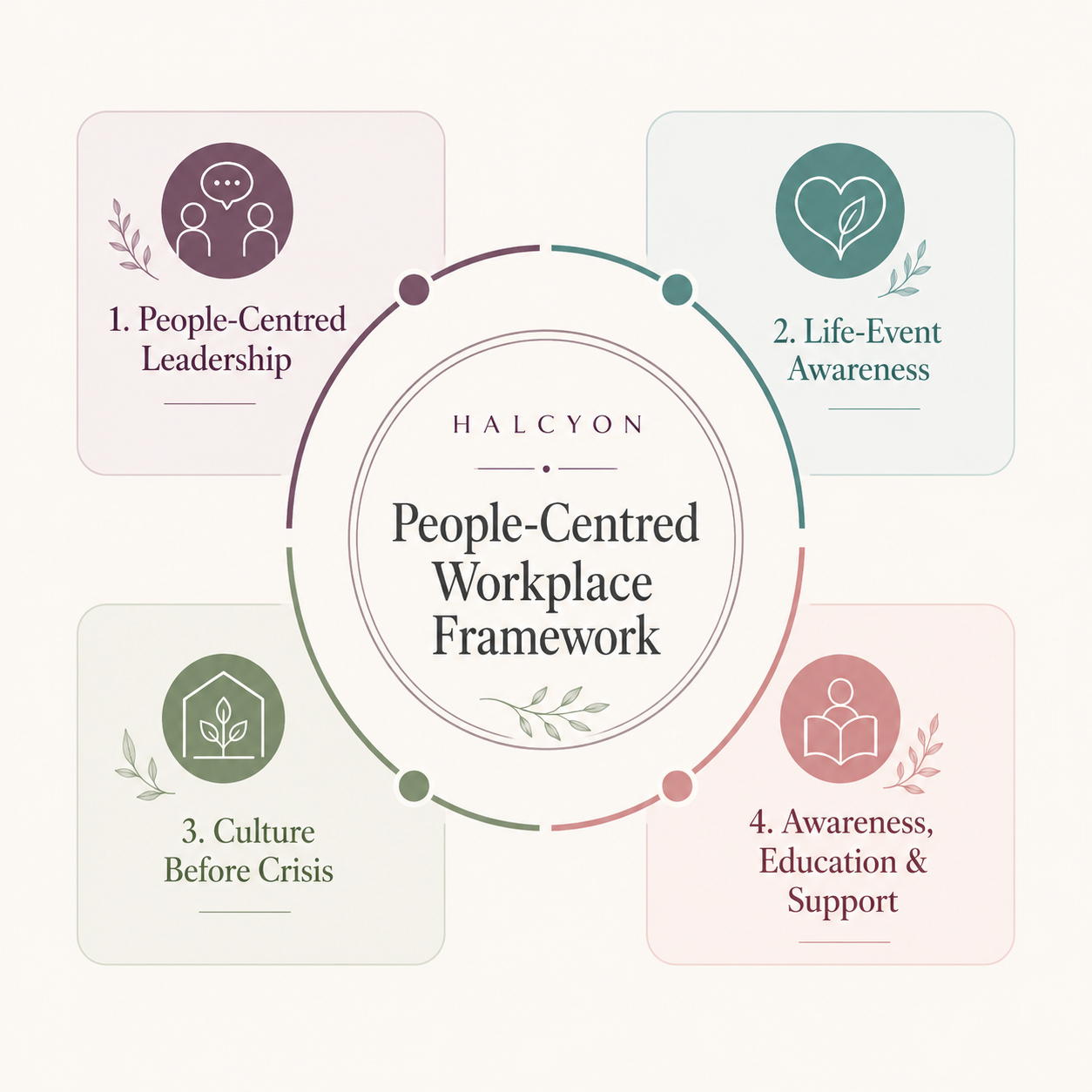
The Halcyon People-Centred Workplace Framework
The Halcyon People-Centred Wellbeing Framework helps organisations translate these ideas into a practical structure that supports both people and performance.
It is built around four interconnected pillars.
People-Centred Leadership
Supporting leaders and managers to respond to the realities of human life with confidence, compassion and clarity. Leadership guidance helps managers navigate sensitive conversations and create environments where people feel safe being honest about the challenges they may be facing.
Life-Event Awareness
Recognising that experiences such as fertility journeys, pregnancy loss, menopause, illness, caring responsibilities and grief are natural parts of life.
Through training and thoughtful policy design, organisations can ensure these realities are understood and supported appropriately.
Culture Before Crisis
Designing workplace environments and everyday practices that support wellbeing proactively rather than reacting only when problems arise.
This includes flexible approaches to work rhythms, supportive environments and opportunities for connection, reflection and recovery.
Awareness, Education & Support
Helping staff recognise and respond to their own wellbeing needs through education, training and access to supportive resources.
This may include leadership education sessions, staff awareness training, wellbeing clinics and connections with trusted local support services.
Start Here: People-Centred Workplace Snapshot
If you are not sure whether your organisation’s caring culture is translating into consistent staff experience, the best place to start is the Free People-Centred Workplace Snapshot.
This short leadership diagnostic helps you reflect on how well your organisation currently supports people through sensitive conversations, real-life events, workplace pressure and everyday wellbeing.
It is designed to help you notice where support may be strong, where it may depend too heavily on individual managers, and where you may be relying on assumption rather than evidence.
It explores areas such as:
- leadership confidence
- manager consistency
- sensitive conversations
- life-event awareness
- staff signposting
- policy clarity
- psychological safety
- everyday wellbeing culture
- whether you have evidence of current gaps
The Snapshot is free to complete and takes around 10–15 minutes.
Once submitted, Halcyon will review your responses and suggest possible next steps.
This is not a formal legal, HR or clinical audit. It is a practical starting point.
Manager Training - Having Difficult Conversations
Policies matter.
But policies do not speak to staff - people do.
Managers are often the first people staff speak to when something difficult is happening and the way that first conversation is handled can shape everything that follows.
A thoughtful response can build trust, reduce fear and help someone access support earlier.
An awkward, avoidant or overly formal response can leave staff feeling exposed, dismissed or unsafe, even when the organisation’s intentions are good.
Having Difficult Conversations is practical training for managers, people leaders and HR teams who want to respond to sensitive situations with more confidence, compassion and clarity.
It supports managers to handle conversations around
grief,
health,
menopause,
fertility,
pregnancy loss,
domestic abuse,
burnout,
caring responsibilities,
conflict,
emotional distress and other real-life pressures that affect people at work.
The session helps managers understand:
- why sensitive conversations can feel difficult
- how to create safer, clearer conversations
- what to say when someone discloses something personal
- how to listen without overstepping
- how to balance compassion with boundaries
- when to signpost, escalate or seek further guidance
- how to avoid common mistakes that can damage trust
- how to create more consistent staff experiences across teams
You can book individual places on the training here. Alternatively, this can be delivered as a standalone session for your organisation or as part of a wider Person-Centred Workplace Framework.
You can find out more about my range of training options here.
Next Steps - Working With Halcyon
After the Snaphot, the Staff Experience Pulse check
The Free Person-Centred Workplace Snapshot helps you reflect on your organisation’s current culture, leadership confidence and support structures.
If your responses suggest that it would be useful to hear directly from staff, you may be invited to undertake a Person-Centred Staff Experience Pulse.
The Staff Experience Pulse is a confidential staff questionnaire designed to help you understand what may be affecting your people at work, how safe they feel raising sensitive issues, and how confident they are that the organisation would support them through difficult times.
For an introductory rate of £395, Halcyon will create a dedicated questionnaire link for your organisation, manage the response window, review responses thematically, and provide a short findings report with practical recommendations and suggested next steps.
This includes up to 50 staff responses.
Larger teams or whole-organisation rollouts can be quoted separately.
THEN...
Light Touch
If it feels like a fit, you can commission a half- or full-day strategic exploratory session, where Sarah joins you and your Leadership Team to explore exactly the type of culture you want to create.
The kind of service you want to give.
How you want your staff, customers, and partners to feel when they work with you.
What sort of an employer you want to be.
We'll look at things that you may not have thought of before.
And help you tackle the things you had thought of, but didn't know where to start.
And you'll get a personalised roadmap afterwards, that outlines key considerations and next steps for your organisation.
Going on to Devise your People-Centred Wellbeing Framework
When you're ready, we will work together to develop, implement and maintain your People-Centred Wellbeing Framework.
The full framework is in 3 sections.
The first is the review / development of staff policies and pledges.
The second - leadership training, staff awareness-raising and embedding human-ness into your core structures.
And the third section is the continued relationship through ongoing advisory support, management training and staff wellbeing education.
Our aim is not simply to introduce wellbeing initiatives, but to create a structure that allows your organisation to grow without losing the human culture it was built on.
You can work with me just for the first stage, the first and second stage or all 3.
There is no right or wrong apporach - just the best one for where your organisations is at the moment.
Who is this for?
This work is particularly suited to organisations that already care deeply about their people and want to protect that culture as the business grows.
This often includes
- founder-led organisations who want to maintain a human culture as leadership structures develop
- growing SMEs (typically 10–150 employees) beginning to formalise policies and leadership responsibilities
- professional services, creative and consultancy firms where relationships, reputation and culture are central to success
- leadership teams who recognise that life events impact work and want practical ways to support their teams without creating unnecessary bureaucracy
This work is not about introducing complex HR systems or performative wellbeing programmes. It is about designing organisations where people can navigate real life while continuing to do meaningful work together.
About Halcyon
Halcyon was founded by Sarah Darwen, a workplace wellbeing consultant and menstrual health specialist with over fifteen years’ experience supporting individuals and organisations to navigate health, life transitions and wellbeing challenges.
Alongside her clinical work supporting women, Sarah has extensive experience in organisational leadership, service design and wellbeing strategy.
Her work combines evidence-based wellbeing approaches with a deep understanding of how real life impacts the workplace.
Through Halcyon, Sarah now works with founders and leadership teams to design human-centred workplace frameworks that allow organisations to grow while protecting the values and culture they were built on.
Let's start with a Conversation
A 30–45 minute exploratory call allows us to discuss your organisation, the challenges you’re seeing and whether the Halcyon approach may be helpful.
Copyright ©2025 Halcyon Therapies Ltd, All Rights Reserved.
Halcyon, Halcyon Women's Health, Halcyon Days and the Corporate Witch are registered Trademarks and trading names of Halcyon Therapies Ltd, Company number 11204967), Unit 12 Guest House Farm Runshaw Lane, Euxton, Chorley, Lancashire, England, PR7 6HD Clinic space located at Room 5, 107-109 Towngate in Leyland PR25 2LQ